



How Long Does Unemployment Last in Ohio? – 2026
Losing a job brings immediate financial stress and a wave of urgent questions. Navigating the Ohio Department of Job and Family Services (ODJFS) portal can feel overwhelming, especially when you are trying to calculate your financial runway. If you are trying to figure out your timeline, the absolute baseline question is: how long does unemployment last in Ohio?
In Ohio, your regular benefit runway depends entirely on your prior work history, but standard claims are restricted by strict state limits. This guide—fact-checked against current 2026 state criteria—breaks down exactly how long do unemployment benefits last in Ohio, what it takes to qualify for maximum weekly compensation, and how to successfully navigate the state’s newly upgraded filing infrastructure.
Key Takeaways
- In 2026, most eligible Ohio workers can receive between 20 and 26 weeks of regular unemployment benefits within a single 52-week benefit year, depending on the number of qualifying weeks in their base period.
- There are currently no automatic extensions in place. The federal Extended Benefits (EB) program only activates during periods of very high statewide unemployment and is not active in Ohio as of mid-2026.
- Your benefit year is a 52-week clock that starts the week you file your initial claim. Unused weeks cannot carry into a new benefit year.
- The maximum weekly benefit amount for 2026 ranges from $624 with no dependents up to $842 with three or more dependents, while the maximum number of payable weeks remains capped at 26.
- Keeping benefits for the full possible duration requires you to file weekly claims, remain actively seeking work, and report all earnings honestly, including any income from covered employment or part-time positions.
How Long Does Unemployment Last in Ohio in 2026? (Quick Answer)
Most eligible Ohio claimants can receive between 20 and 26 weeks of unemployment benefits within one 52-week benefit year. Ohio unemployment benefits last up to 26 weeks, which is the statutory maximum duration for regular state benefits in 2026. However, not every worker qualifies for the full 26 weeks. Benefits duration depends on work history and unemployment length, specifically the number of qualifying weeks and wages in your base period.
Before your first payment arrives, Ohio applies a mandatory one-week unpaid waiting week. You must still file a claim for that first week to receive credit, but you will not be paid for it. This waiting week counts against your benefit year.
You also cannot collect benefits for weeks before your application date. The clock starts when you file, not when you lost your job, so it pays to start filing as soon as you become unemployed.
As for extensions beyond 26 weeks, the federal-state Extended Benefits program is currently not active in Ohio. No pandemic-era programs like PEUC or PUA remain in effect. Unless economic conditions deteriorate sharply, claimants should plan around the standard 20–26 week window.
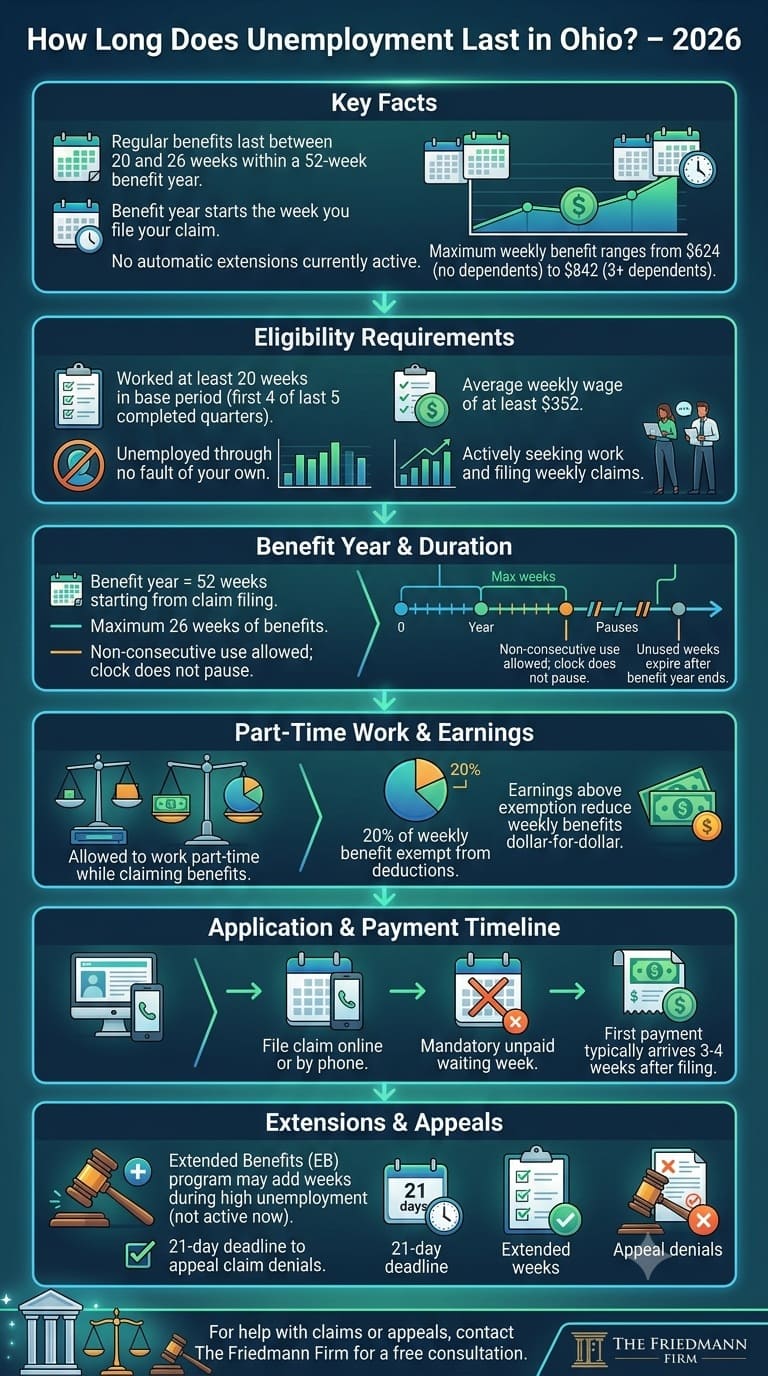
Understanding the 52-Week “Benefit Year” and How It Limits Duration
Under Ohio Revised Code § 4141.01, a benefit year is a fixed 52-week period that begins on the first day of the week in which you file a valid application for unemployment compensation. This clock governs everything about your regular state claim.
Within that benefit year, Ohio law caps regular benefits at a maximum of 26 payable weeks. Even if you remain unemployed for longer than six months, you cannot receive more than 26 weeks of regular state payments during a single benefit year.
You cannot start a second new claim for additional weeks until the benefit year fully expires. The 52-week clock continues to run whether you are filing weekly or not. If you stop filing because you took a short-term contract, the clock does not pause.
This is where non-consecutive use matters. If you temporarily return to work during the benefit year, you stop filing weekly certifications and your claim pauses. If that job ends and you are still within your original 52-week window with unused weeks remaining, you can reopen your existing claim and resume collecting unemployment. Benefits may stop if a recipient returns to full-time employment, but the unused portion can be tapped later if the benefit year has not expired.
When the benefit year ends, any unused weeks are permanently lost. Filing a new claim requires new covered employment and sufficient wages in a fresh base period.
How Ohio Calculates Your Maximum Weeks (20–26) From Your Work History
Your total potential weeks of unemployment insurance depend on your qualifying weeks of work in your base period, not just the length of your most recent job.
A qualifying week in 2026 means any calendar week in which you earned at least a minimum average weekly wage threshold in covered employment. For 2026, you must have earned an average of at least $352 per week in gross earnings before taxes or other deductions. You must have worked at least 20 weeks in the last 12–18 months to establish a valid claim.
The exact number of weeks of benefits depends on qualifying work weeks in the base period. Workers with exactly 20 qualifying weeks will generally qualify for about 20 payable weeks. Those with more qualifying weeks-say 28-can unlock the full 26 weeks allowed under § 4141.30. Ohio’s proration formula awards one additional week for each qualifying week beyond 20, up to the 26-week cap.
Here is a simplified view:
| Qualifying Weeks in Base Period | Approximate Payable Weeks |
| 20 | 20 |
| 22 | 22 |
| 24 | 24 |
| 26+ | 26 (maximum) |
The Ohio Department of Job and Family Services uses both your weeks of work and your wages to decide the exact duration. After you file, you will receive a monetary determination letter that spells out how many weeks you qualify for and your weekly benefit amount.
Base Period vs. Alternate Base Period: Why They Matter for Duration
Ohio decides whether you are eligible for unemployment-and for how long-by examining your work and wages during a defined base period.
The base period is the first four of the last five completed calendar quarters before the week you file your initial claim. For example, if you file in August 2026, your regular base period covers April 1, 2025, through March 31, 2026. The most recent quarter (April–June 2026) is excluded under this standard calculation.
If you do not have enough qualifying weeks or wages in the regular base period, you can ask ODJFS to evaluate your application using the alternate base period. Under ohio law, the alternate base period uses the last four completed calendar quarters immediately before your claim. This lookback can capture more recent wages that the standard formula would miss.
The alternate base period is particularly helpful for people who recently returned to work after an illness, finished school, or came back from family leave. Recent wages in the most recent quarter that the standard formula skips can make the difference between qualifying and being turned away.
Neither base period option changes the 26-week statutory cap. But the right base period can be the difference between qualifying for only a handful of weeks versus the full allowable duration-or not being eligible for unemployment benefits at all.
Eligibility Requirements That Control Whether Your Weeks Get Paid
Being approved for a certain number of weeks does not guarantee you will be paid for all of them. You must satisfy ongoing eligibility requirements every single week you claim benefits.
Ohio’s core eligibility rules require that you be totally or partially unemployed through no fault of your own and have enough qualifying weeks and wages in covered employment during the base or alternate base period. You must be unemployed through no fault of your own-this is non-negotiable.
Situations that typically qualify include corporate layoffs, plant closures, seasonal reductions, and elimination of your position. Common situations that may disqualify or delay benefits include quitting without just cause, being fired for misconduct, refusing suitable work, or a disciplinary layoff tied to violation of company policy. If your former employer disputes your separation, your claim may be held while ODJFS investigates.
Every week you file, you must also be:
- Physically and mentally able to work in your regular occupation or other suitable work
- Available to accept a job if one is offered
- Actively seeking work through documented job search activities
You must be actively seeking work to qualify for benefits, and to maintain eligibility, claimants must document job search activities each week. ODJFS may require participation through OhioMeansJobs or other approved programs.
Failing to meet eligibility requirements can lead to reduced or terminated benefits. Even one missed week of compliance can result in a denial for that specific week, effectively shortening the total number of weeks you actually collect benefits compared to your maximum entitlement.
Weekly Benefit Amounts in 2026 and How They Shape Your Runway
Your weekly benefit amount does not change how many weeks you can get, but it determines how much financial support you have during those weeks. Together, the WBA and duration define your total unemployment compensation runway.
In Ohio, your weekly benefit is generally about 50% of your average weekly wage in the base period, up to a statutory maximum that depends on the number of allowable dependents. If you are claiming dependents, you may qualify for a higher cap.
Here are the 2026 maximum WBA figures:
| Number of Allowable Dependents | Maximum Weekly Benefit Payout | Required Minimum Average Weekly Wage to Max Out |
| 0 Dependents | $624 | $1,248 |
| 1 to 2 Dependents | $757 | $1,514 |
| 3 or More Dependents | $842 | $1,684 |
The maximum weekly benefit is $624 in 2026 for claimants without dependents. These caps are adjusted annually based on Ohio’s statewide average weekly wage, as outlined in ODJFS policy guidance.
The combination of WBA and weeks creates a total benefit cap for your entire benefit year. A worker at the $624 weekly maximum who qualifies for the full 26 weeks has a total possible benefit pool of $16,224 before taxes. A worker with three or more dependents at the $842 cap could receive up to $21,892 over 26 weeks.
Use your monetary determination letter or the official ODJFS benefits estimator to forecast how long your unemployment compensation can realistically cover living expenses.
Working Part-Time While Collecting Unemployment: Impact on Weeks and Amounts
Ohio allows you to work part-time and still receive benefits, as long as all earnings are reported transparently when filing weekly claims. Receiving part-time income can reduce weekly benefit amounts in Ohio, but it does not automatically end your claim.
Ohio uses a 20% earnings disregard rule. You may earn up to 20% of your weekly benefit amount in any given week without any reduction. Earnings above that exempt portion are deducted dollar-for-dollar from that week’s check.
Consider a claimant with a $400 WBA:
| Scenario | Part-Time Wages | 20% Exemption | Deduction | Final Weekly Payout |
| Low earnings | $70 | $80 (exempt) | $0 | $400 |
| Moderate earnings | $200 | $80 (exempt) | $120 | $280 |
| High earnings | $400+ | $80 (exempt) | Full offset | $0 |
If your gross earnings equal or exceed your WBA, you receive no benefit for that week. However, skipping benefits in one week because wages were too high does not automatically extend your benefit year. The 52-week clock still runs, but uncollected payable weeks may be used later in the year if you again earn below your WBA.
Failing to report part-time earnings-no matter how small-can trigger overpayment findings, fraud penalties, loss of remaining weeks, and potentially a ban from Ohio’s unemployment program in the future. Report every dollar during the week it is earned, not the week you receive the paycheck.
How Long It Takes to Get Paid in Ohio (Processing Timelines)
The number of weeks you are eligible for is different from how long it takes to receive the first payment. It takes about 3 weeks to get a decision on your application, and most Ohio claimants should plan for a gap of roughly three to four weeks before money arrives.
Two factors drive this delay:
- The unpaid waiting week. Ohio applies a mandatory, unpaid one-week waiting period for all initial claims. You must still file your claim for this first week to receive credit, but you will not be paid for it.
- Employer verification. ODJFS must contact your former employer to confirm wages and the reason for separation. If your employer failed to respond or disputes the claim, this step can take longer.
You can apply for unemployment benefits online or by phone. To minimize delays, file online at unemployment.ohio.gov using an OH|ID account as soon as you become unemployed. Respond quickly to any ODJFS requests for additional information. If your claim shows pending issues, call the helpline (1-877-644-6562) early in the day, ideally mid-week to avoid Monday backlogs.
After filing, you will receive a new claim instruction sheet that outlines your responsibilities and next steps. Keep this document-it contains your e mail address confirmation details, your state id number reference, and instructions for maintaining your claim.
Once the claim is approved and direct deposit is set up, later weekly payments typically arrive within a few business days after you file each weekly claim, provided there are no new issues or earnings flagged that week.
State Eligibility & Base Period Requirements in Ohio?
You cannot simply lose a job and immediately collect a check; you must have paid enough into the system via “covered employment” to draw from it.
Base Period Requirements
When calculating how long do you have to work to get unemployment in Ohio, ODJFS looks back at your regular base period. This is defined as the first four of the last five completed calendar quarters prior to the date you file your initial application.
To establish a valid claim in 2026, you must meet two concurrent benchmarks:
- The Time Requirement: You must have worked at least 20 weeks within that one-year base period.
- The Wage Requirement: In those 20+ weeks, your average weekly earnings must be at least $352 before taxes or any other workplace deductions.
| 2026 Quick Eligibility Matrix | Ohio State Minimum Criteria |
| Minimum Weeks Worked | 20 weeks in a covered base period |
| Minimum Average Weekly Wage | $352 (Gross earnings before tax) |
| Maximum Standard Benefit Duration | 26 weeks per benefit year |
| Appeal Filing Deadline | Strict 21-day window from mailing date |
If your regular work history falls short because you were recently hired or experienced an illness, ask ODJFS to evaluate your application using the Alternate Base Period (the last four filled calendar quarters). This alternate lookback ensures that short-term gaps do not completely strip away your right to benefits.
Partial Payout Reduction Model (Based on a $400 Regular WBA)
| Financial Line Item | Scenario A: Earning $70/wk | Scenario B: Earning $200/wk |
| Weekly Benefit Base | $400.00 | $400.00 |
| 20% Earnings Exemption Buffer | $80.00 (Exempt) | $80.00 (Exempt) |
| Reported Gross Part-Time Wages | $70.00 | $200.00 |
| Calculated State Benefit Deduction | $0.00 (Wages below exemption) | $120.00 ($200 total – $80 exempt) |
| Final Adjusted Weekly Payout | $400.00 | $280.00 |
If your gross part-time earnings match or exceed your weekly benefit amount, your payout drops to zero for that week. Understanding this calculation is crucial for maintaining your benefits, as failing to declare minor part-time shifts can trigger fraud flags and immediately suspend your claim.
Streamlining Your Claims Portal Experience
To avoid extended processing black holes, log into the official unemployment.ohio.gov portal during off-peak windows—ideally early morning or late evening—to prevent systemic site time-outs. If you ever need to speak to an agent directly to clear a pending flag, call the helpline midway through the week (Tuesday through Thursday) right when the lines open at 8:00 AM EST to bypass the massive Monday backlogs.
To minimize processing blockages within Ohio’s modernized cloud infrastructure, execute your application systematically using the designated state pipeline:
- Establish an OH|ID Identity Profile: Navigate to unemployment.ohio.gov to create and verify your centralized state identity profile (OH|ID). Enter a secure email to receive your 6-digit security code.
- Compile Verification Details: Gather your SSN, driver’s license/state ID, dependent info (names, birthdates, SSNs), and full employment/payroll addresses for all employers over the past 6 weeks.
- Submit Initial Claim Application: Log into the worker portal using your authenticated credentials, select “File a New Claim for Unemployment Benefits,” complete the separation questionnaire, and input direct deposit information to prevent check delivery delays.
- Maintain Mandatory Weekly Certifications: Log into the portal weekly (between Sunday and Friday). You must log at least three valid job-seeking activities per week to keep your claim active.
Unemployment Extensions in Ohio: When More Than 26 Weeks Is Possible
Under normal economic conditions, Ohio only offers up to 26 weeks of regular state benefits. There is no personal extension you can apply for when those benefits run out.
The federal-state Extended Benefits (EB) program can activate when Ohio’s unemployment rate crosses specific thresholds. Extended Benefits can add up to 13 additional weeks in some circumstances, and in periods of extremely high statewide unemployment, up to 20 additional weeks become available.
Extended Benefits may provide additional weeks during high statewide unemployment, but as of mid-2026, EB is not active in Ohio. There are no ongoing pandemic-era programs. Unemployed workers should not count on future extensions when building a financial plan.
If EB or another temporary program is triggered in the future, ODJFS typically sends notices to claimants who have exhausted or are close to exhausting regular benefits, with instructions on how to apply or transition. The federal government funds a portion of these extended programs, while the state covers the rest.
Financial planning should be grounded in the known 20–26 weeks of regular benefits and your current WBA. Treat any future extension as a potential bonus, not a guarantee.
Handling Claim Denials, Overpayments, and Appeals in Ohio
Denials, reductions in weeks, or overpayment notices can all shorten the time you actually collect benefits. If you are denied unemployment benefits, Ohio provides a structured appeal process-but the deadlines are strict.
If ODJFS denies your claim or disqualifies you for certain weeks (for example, finding you quit without just cause or were fired for misconduct related to company policy), you will receive a written determination called a denial notice. You have 21 days to appeal a denial notice from the date it was printed and mailed.
Appeals can be submitted electronically or by mail. You can file your written appeal through the ODJFS online portal, by fax, or by postal mail. During the appeal process, continue to file weekly claims. If the decision is reversed, you can receive back pay for all weeks you certified and later approved.
Here is how the appeals ladder works:
- ODJFS has 21 days to respond to your appeal with a redetermination.
- You can appeal a redetermination within 21 days to the unemployment compensation review commission (UCRC) for a hearing before a hearing officer.
- If the UCRC decision is unfavorable, you may further appeal. You may appeal to the common pleas court within 30 days of the UCRC decision.
An employer appeal of your eligibility follows a similar timeline. If your former employer disputes your claim, you will receive notice and have the opportunity to present evidence.
Overpayment determinations can require repayment or allow offset by reducing future weeks of benefits. Intentional misrepresentation-like failing to report earnings-can lead to penalties, a loss of additional weeks, and potential criminal charges.
How Other Income (Severance, Vacation, Pensions) Affects Your Weeks
Certain types of income paid after separation can reduce or delay unemployment benefits, effectively shrinking the number of weeks you are paid within your benefit year.
Under ohio law, severance pay is treated as remuneration. If your employer allocates a severance package to specific weeks after separation, those weeks may be non-payable for unemployment. If no allocation is provided by the employer, ODJFS uses a default method to spread the severance amount across multiple weeks based on your normal weekly wage, which can reduce your benefits to zero for an extended stretch.
Unused vacation or holiday pay designated for weeks after separation can also reduce or eliminate benefits for those weeks. A payout of accrued time at the exact moment of separation may have less ongoing effect, but the treatment varies. Check current ODJFS guidance for the precise rules that apply to your situation.
Certain pension or retirement payments may offset unemployment benefits depending on who funded the plan and the amount received. However, Social Security retirement benefits typically do not reduce Ohio unemployment compensation.
Because these offsets are calculated week by week, they can cause a claimant to burn through the 52-week benefit year without actually being paid for all 20–26 potential weeks. If you received a severance package, lump-sum vacation payout, or pension, contact ODJFS for a personalized explanation of how your pay package will be treated before assuming you have enough money to cover six months of expenses.
Using OhioMeansJobs and ODJFS Family Services to Shorten Unemployment
The goal is not just to maximize weeks of unemployment. It is to use state resources to return to covered employment as quickly as possible.
The ohio department of job and family services partners with local OhioMeansJobs centers to provide free job-search assistance, resume help, interview coaching, and training referrals. These resources are available to all unemployed workers in Ohio, regardless of whether they are currently receiving benefits.
Participation in certain reemployment services or training programs recommended by ODJFS can count toward your weekly work-search requirement. This means you maintain eligibility while actively improving your job prospects and building new job skills-a win on both fronts.
Families facing prolonged unemployment may also qualify for related family services like food assistance, Medicaid, or childcare support. These programs, also administered through job and family services offices, can stabilize a household while the primary earner searches for work.
Register at OhioMeansJobs.com soon after filing for unemployment. The platform allows you to track job applications, document work-search efforts, and access listings that match your regular occupation or transferable skills. Federal government employment listings and out of state employment opportunities are also searchable through the system. Even positions with religious organizations or military service transition programs may appear.
Consolidated Eligibility and Work History
Your total potential weeks of unemployment insurance depend on your qualifying weeks of work and wages in your base period, not just the length of your most recent job. Ohio requires that you have worked at least 20 weeks within your base period, defined as the first four of the last five completed calendar quarters before your claim, earning an average of at least $352 per week before taxes and deductions.
The exact number of payable weeks ranges from 20 to 26, increasing incrementally for each qualifying week beyond 20. The Ohio Department of Job and Family Services (ODJFS) will send a monetary determination letter detailing your approved weeks and weekly benefit amount.
Job Duties and Suitable Work Requirements
Eligibility for unemployment benefits also depends on your ability and availability to accept suitable work. Ohio requires that you seek and accept jobs that reasonably match your prior job duties, skills, training, and experience. If you refuse a job offer because it does not align with your previous job duties or is unsuitable given your qualifications, you may risk losing benefits unless you have just cause.
Maintaining eligibility means actively searching for work within your field or comparable positions. ODJFS may review your job search activities to ensure they align with your skills and prior employment.
Working Part-Time and Earnings Impact on Benefits
Ohio permits part-time work while receiving unemployment benefits, but earnings must be reported for the week they are earned. You can earn up to 20% of your weekly benefit amount (WBA) without deduction. Earnings beyond that are deducted dollar-for-dollar from your weekly benefit.
For example, with a $400 WBA:
- Earnings up to $80 are exempt.
- Earnings above $80 reduce your benefit by the excess amount.
- If earnings equal or exceed your WBA, you receive no benefit that week.
Reporting all earnings promptly is crucial to avoid penalties or claim suspension.
Claim Filing Specifics and Processing Time
You cannot collect benefits for weeks prior to your application date; the benefit year and waiting week begin the week you file your claim. Ohio applies a mandatory unpaid waiting week, which you must claim but will not be paid for.
Expect about 3 to 4 weeks from application submission to your first payment due to employer verification and processing. To avoid delays:
- File online promptly at unemployment.ohio.gov.
- Respond quickly to ODJFS requests.
- File weekly claims on time.
- Use off-peak hours to access the portal and call helplines mid-week early mornings.
Common Reasons for Denial Related to Job Duties and Misconduct
Claims may be denied if you:
- Quit without just cause related to your job duties.
- Were fired for misconduct, such as failing to perform essential job duties or violating company policies.
- Refuse suitable work without valid reasons.
- Fail to actively seek work consistent with your skills and prior employment.
Understanding these reasons helps you maintain eligibility and prepare for potential appeals.
Impact of Training or School on Benefits
Returning to school or training does not automatically disqualify you from benefits. However, if your class schedule limits your availability for suitable full-time work, ODJFS may find you ineligible for some weeks. Participation in approved training programs may count toward your work search requirements and help maintain eligibility.
Planning Your Financial Runway: Making 20–26 Weeks Last
Knowing the maximum number of weeks is only useful if you turn that information into a realistic budget and job-search plan.
Start by calculating your total potential unemployment benefits: multiply your WBA by the number of weeks ODJFS approved (up to 26). If your WBA is $500 and you are approved for 24 weeks, your gross benefit pool is $12,000. If you opt to have federal and state income taxes withheld from each payment, adjust that number downward-unemployment benefits are taxable income, and you will receive Form 1099-G at year’s end.
Build a simple month-by-month plan that aligns expected unemployment income with essential expenses:
- Housing (rent or mortgage)
- Utilities
- Food
- Transportation
- Debt minimums
- Insurance premiums
Trim non-essentials as early as possible. The first few weeks of unemployment often feel manageable; the financial pressure compounds as weeks pass.
Set clear job-search milestones tied to your benefit timeline. For example, if you are still unemployed at the halfway mark, consider widening your search radius, accepting slightly lower pay, or pivoting to adjacent industries. Look into training options through OhioMeansJobs or community colleges.
If job prospects look weak at the midpoint, proactively explore part-time or temporary work. Even limited hours can stretch your benefit duration by reducing the weekly draw. A step by step guide from an ODJFS counselor can help you map out your options based on your specific situation, including your driver’s license status, birth date for age-related programs, your alien registration number if applicable, and the expiration date of any certifications.
What to Do If Your Ohio Claim Is Denied
If you receive an official determination notice stating you are disqualified—perhaps because your former employer claims you quit voluntarily or were terminated for misconduct—remember that you have legal recourse.
You have a strict 21-day deadline from the date the determination notice was printed and mailed to submit a formal, written appeal. Do not let your eligibility clock run out. Keep submitting your weekly claims on time while your appeal is pending; if the state reverses its decision during the review hearing, you will receive a retroactive lump-sum payout for every week you certified successfully.
Maximizing Your Payout Window
Understanding how long can you receive unemployment in Ohio means knowing the rules required to keep your claim active. If you make a mistake on your weekly certification, the state can stop your benefits immediately.
Maintain Your Eligibility Checklist
- Actively Seek Work: You must complete and document a minimum of three job-seeking activities each week, such as submitting a resume, interviewing, or attending a local OhioMeansJobs workshop.
- Report All Part-Time Earnings: You can work part-time while collecting benefits, but you must report every dollar earned during the week worked (not when paid). Refer to the ‘Working Part-Time Calculations’ section for exemption details.
- Be Available and Able: If you are too sick to work or take an extended vacation out of state, you must declare that you were unavailable for work during those specific days on your weekly claim.
Ultimately, preserving your regular benefit duration rests on strict compliance. As long as you submit accurate weekly data, actively look for a replacement job, and remain out of work through no fault of your own (such as a standard corporate layoff or facility downsizing), you can count on those regular state resources to cushion your transition for up to 26 weeks.
When to Talk to an Ohio Unemployment or Employment Lawyer
While many straightforward layoffs move through the system without legal help, certain issues can directly cut down the weeks you are allowed to collect and may justify consulting an attorney.
Common scenarios that benefit from legal advice include:
- Your former employer disputes that you were laid off and alleges you quit
- Accusations of misconduct, including violations of company policy or alleged insubordination
- Complex severance or non-compete agreements that affect benefit timing
- Alleged overpayments or fraud determinations
- Delayed or confusing determinations that threaten to reduce your benefits
- Sexual harassment or hostile work environment claims tied to your separation
- Disputes involving federal government employment or most employers in specialized industries
An experienced Ohio unemployment or employment lawyer can help gather evidence, interpret ODJFS notices, prepare for unemployment compensation review commission hearings, and craft arguments about eligibility and benefit duration. For example, they can help demonstrate that you had just cause to quit or that you remain able and available for suitable work despite a partial disability.
If you are facing an imminent loss of benefits, seek a free consultation sooner rather than later. The 21-day appeal deadline is strict, and missing it can permanently limit the weeks you recover.
This article is for informational purposes only, is based on 2026 rules that can change through legislation like House Bill 376, and is not a substitute for personalized legal advice from a licensed Ohio attorney.
Conclusion: Navigating Ohio Unemployment Duration With Confidence
In 2026, regular Ohio unemployment generally lasts between 20 and 26 weeks within a 52-week benefit year, with no active extensions in place. The exact number of weeks depends on your base-period work history, qualifying wages in covered employment, and continued weekly eligibility-ability to work, availability, active work search, and honest reporting.
While the system can feel complex, understanding the benefit year, weekly filing requirements, and interaction with part-time work or severance puts you in a much stronger position to plan ahead. Every week you file accurately and remain in compliance is a week you protect.
Combine your unemployment benefits with OhioMeansJobs resources, careful financial planning, and-when needed-legal guidance to bridge the gap to your next job without unpleasant surprises about how long support will last. If you believe you have been wrongly denied unemployment benefits or face other factors complicating your claim, contact The Friedmann Firm today for a free consultation and take the first step toward protecting the benefits you have earned.
Frequently Asked Questions
Can I start a new Ohio unemployment claim as soon as my 26 weeks run out?
You generally cannot file a new claim until your current 52-week benefit year has fully expired, even if you used up all 26 weeks earlier in that year. To qualify for a new benefit year, you must also have new covered employment and sufficient wages in the new base period. Simply remaining unemployed does not reset eligibility. You need to have earned enough money in new qualifying weeks to meet the minimum thresholds again.
What happens to my remaining weeks if I move out of Ohio?
You can usually continue to receive Ohio benefits after moving, as long as you remain able, available, and actively seeking work in your new location and keep filing weekly claims with ODJFS. Out of state employment searches count toward your work-search requirement. Interstate claims can be more complicated and may require coordination between Ohio and your new state’s unemployment agency, which can affect processing times but does not change the original 26-week cap. You will still receive notice of any issues through your registered e mail address.
Does going back to school affect how long I can receive unemployment in Ohio?
Enrolling in school does not automatically end benefits. However, if your class schedule makes you unavailable for full-time suitable work or restricts you from accepting jobs, ODJFS may find you ineligible for some or all weeks. Claimants considering school or training should speak with an OhioMeansJobs counselor, since some approved training programs are compatible with continuing benefits and can count toward your work-search activities.
Can I pause my claim if I take a short-term job and then restart it later?
Yes. You can stop filing weekly claims when you return to work. If the job ends before your 52-week benefit year expires and you still have unused weeks, you may be able to reopen your existing claim rather than filing a new claim. The benefit year’s end date does not change, so extended breaks from filing do not extend the 52-week window. Contact ODJFS promptly to reactivate your claim and avoid losing payable weeks.
Are Ohio unemployment benefits taxable, and can taxes change how long they last?
Ohio unemployment benefits are taxable for both federal and state income tax purposes. ODJFS will issue Form 1099-G after year-end. Taxes reduce the amount you keep each week but do not change how many weeks you can receive benefits. You can opt to have taxes withheld from each payment by submitting Form W-4V, or you can handle the obligation when filing your annual return. Planning for taxes upfront prevents an unexpected bill in April.
What happens if my severance pay overlaps with my unemployment claim?
Under Ohio law, severance or termination pay is considered remuneration and directly reduces your unemployment benefits for the weeks the payment covers. How it impacts your claim depends entirely on how the payment is allocated by your former employer. If your employer specifically designates the entire lump sum to your exact week of separation and notifies the ODJFS, you will likely only lose benefits for that single week. However, if no specific allocation period is designated, the ODJFS uses a default method to spread the severance amount across multiple weeks based on your normal weekly wage, which can reduce your benefits to zero for an extended period.
Can I collect unemployment if I refuse a job that does not match my previous job duties?
You must accept suitable work that reasonably matches your skills and prior job duties. Refusing suitable work without just cause can lead to denial of benefits.
How does working part-time affect the duration of unemployment benefits?
Part-time earnings reduce your weekly benefit amount but do not extend the total number of weeks you can collect benefits. The 52-week benefit year continues to run regardless of earnings.
What documentation is needed to prove job search activities?
You should keep records such as applications submitted, interviews attended, resumes sent, and participation in job workshops. ODJFS may request this documentation to verify your active job search.
Can severance pay affect how long I can collect unemployment?
Yes, severance pay is treated as remuneration and can reduce or delay your unemployment benefits for the weeks it covers, potentially shortening the payable weeks.
What happens if I move out of Ohio while collecting unemployment?
You can usually continue receiving Ohio benefits if you remain able, available, and actively seeking work, including out-of-state job searches. However, interstate claims may require coordination between states and can affect processing times.
This guide has been compiled as an informational resource for Ohio claimants. For formal representation or specific advice regarding an employment dispute or administrative appeal, please consult directly with a certified legal professional.
