


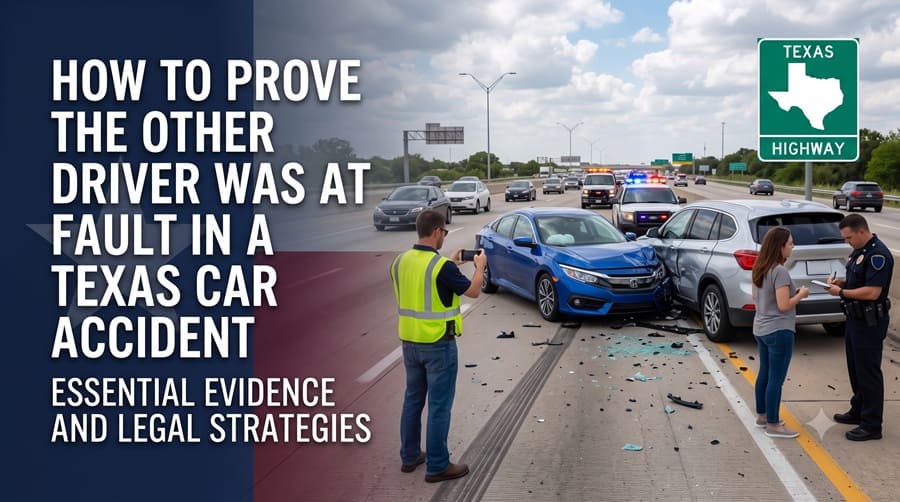
How to Prove the Other Driver Was at Fault in a Texas Car Accident
By Robert W. Hildebrand, Personal Injury Attorney, Hildebrand & Wilson, LLC (Pearland, Texas) | Last reviewed: September 2026
Bottom Line First
In Texas, you prove fault by showing that the other driver broke a duty of care, usually a specific rule in the Transportation Code, and that the violation caused the crash. The proof tends to come from several sources that agree with each other: the CR-3 crash report, photos and video, witnesses, vehicle data, and the physical damage itself.
Fault is also a percentage, not a yes-or-no question. If you’re found more than 50% responsible, you recover nothing; below that, your recovery shrinks by your share. Most claims must be filed within two years.
A crash can leave you rattled for days. You may be hurting, your car may be in the shop, and the other driver’s story may already be shifting. That’s the part that catches people off guard. You know what happened, but knowing it and proving it to an insurance adjuster are two different things.
Fault drives everything that follows: whose insurance pays for repairs, whether medical bills get covered, and whether an injury claim is worth anything at all. Texas is an at-fault state, so the other driver’s liability insurer pays only if you can show their driver caused the crash.
What “Fault” Means Under Texas Law
Legally, fault in a car crash means negligence: the other driver failed to act as a reasonably careful driver would, and that failure caused your injuries. The easiest way to show that is to tie their conduct to a specific rule of the road. A few that come up constantly:
- Running a red light or ignoring a signal: Transp. Code § 544.007
- Following too closely: 545.062, the usual basis for rear-end claims
- Failing to yield on a left turn: 545.152
- Unsafe lane change or failing to stay in a single lane: 545.060
- Texting while driving: 545.4251
Texas then assigns each party a percentage of responsibility under its proportionate responsibility statute. Under Tex. Civ. Prac. & Rem. Code § 33.001, a person more than 50% responsible can’t recover damages. At 50% or less, your award is reduced by your percentage under § 33.012. That’s why insurers so often argue you were “partly” to blame: every point of fault they shift to you lowers what they pay.
Which Evidence Proves Which Fact
One photo rarely proves everything. Strong claims are built from pieces that point the same direction. It helps to think about the specific question each piece of evidence answers:
| The question | Evidence that answers it | How to get it |
| Who had the right of way? | Signal timing, signs and road markings, intersection video, witness accounts | Photos at the scene; requests to nearby businesses; city traffic-signal records |
| How fast was each car going? | Event data recorder (“black box”), dash cam, skid marks, crush damage | Owner consent or court order for EDR data; reconstruction if disputed |
| Where were the cars at impact? | Debris field, resting positions, damage location, the officer’s diagram | Your photos; the CR-3 crash report |
| Was the other driver distracted or impaired? | Phone records, citations, admissions at the scene, officer observations | CR-3; formal discovery in a lawsuit |
| What did the other driver say? | Statements at the scene, texts, recorded insurer statements | Write it down immediately; save messages; witness contact info |
The Texas Crash Report (CR-3): Useful, but Not the Final Word
When a crash causes injury, death, or at least $1,000 in property damage, the investigating officer must file a Texas Peace Officer’s Crash Report (CR-3) within 10 days under Tex. Transp. Code § 550.062. The report typically includes a diagram, contributing factors, citations, witness names, and the officer’s narrative. Access is limited to people directly involved and their representatives under § 550.065; you can buy a copy through TxDOT’s Crash Records Information System for $6, or $8 for a certified copy.
Read it carefully as soon as it’s available. Wrong lane assignments, reversed vehicle numbers, and missing witnesses are more common than people expect, and the investigating agency can sometimes amend a factual error when you bring documentation.
Keep its limits in mind, too. Most officers arrive after the crash and piece together what happened from driver statements and physical clues. A citation is strong evidence in negotiations, but it isn’t a civil finding of fault, and a report that doesn’t cite anyone doesn’t mean nobody was at fault.
If the crash involved a hit-and-run, drivers have a legal duty to stop and exchange information under § 550.021 and § 550.026. Report it to local police right away; the report itself becomes evidence, and it matters for any uninsured motorist claim.
Vehicle Data, Video, and Other Evidence That Disappears
Many newer vehicles have an event data recorder that captures a few seconds of pre-crash information such as speed, braking, throttle, and seat belt use. NHTSA explains what event data recorders capture, and federal rules at 49 C.F.R. Part 563 standardize the data for vehicles that have them. Under the Driver Privacy Act of 2015, though, that data belongs to the vehicle’s owner or lessee. Getting it from the other car usually requires the owner’s consent or a court order, and the car may be repaired or scrapped before anyone asks.
Video is even more fragile. Business security systems and doorbell cameras often overwrite footage within days. Traffic cameras in many Texas cities don’t record at all. If you think a camera caught the crash, ask for the footage in person or in writing right away.
Once a party reasonably anticipates litigation, Texas law expects it to preserve relevant evidence. The Texas Supreme Court set out the framework for spoliation, and the penalties for destroying evidence, in Brookshire Bros. v. Aldridge. A written preservation letter to the other driver’s insurer, a trucking company, or a business with cameras puts them on notice early.
How to Prove Fault When There Were No Witnesses
Plenty of crashes happen with no one else around. Physical evidence then carries the weight. Damage patterns are surprisingly telling: a crushed front bumper on one car and a crushed rear on the other points one way, while damage on the passenger side door at a 90-degree angle points to a side-impact at an intersection. Debris location marks roughly where impact occurred. Tire marks, gouges in the pavement, and where each car came to rest help reconstruct speed and direction.
Your own records help too. A dash cam, phone GPS history, or a car app that logs trips can establish where you were and how fast you were moving. In disputed, serious-injury cases, an accident reconstructionist can tie those pieces together.
What If the Other Driver Changes Their Story?
It happens often. At the scene, a driver apologizes or admits they “didn’t see you.” A week later, their insurer says you ran the light. That’s why anything said at the scene should be written down immediately, with the time and who else heard it, and why texts or messages from the other driver should be saved as screenshots.
Be careful with your own statements too. The other driver’s insurer may ask for a recorded statement. You don’t have to give one, and guessing about speeds or distances can hurt you later. This site’s guide to dealing with insurance adjusters covers what to say and what to hold back.
When the Other Side Says You Were Partly to Blame
Some crashes are genuinely shared. Rear-end collisions usually point to the trailing driver, but not always, for example when the lead driver cut in and braked hard. Left-turn crashes often turn on timing: whether the oncoming driver was speeding or entered on a stale yellow. In those cases, the goal isn’t to prove the other driver was 100% at fault; it’s to keep your share well under the 51% bar and as low as the evidence supports.
Every percentage point matters, because it comes straight off your recovery. For a closer look at how that plays out, see what to do if you’re partially at fault for a car accident.
When the Other Driver Blamed the Sun
Fault disputes don’t always involve a denial. Sometimes the other driver admits the collision but offers an explanation that makes it sound unavoidable. Hildebrand & Wilson handled one such claim, listed on the firm’s case results page: a client was T-boned at an intersection by a commercial van, and the van’s driver said he had been temporarily blinded by glare from the sun. The claim resolved for $120,000.
The glare explanation is common, and it rarely settles the question by itself. A driver who can’t see an intersection clearly is generally still expected to slow down, stop, or yield rather than drive through blind. What tends to matter is the evidence around it: the time of day and direction of travel, the signal sequence, the van’s speed on approach, and whether the client had the right of way.
Past results do not guarantee a similar outcome. Every case depends on its own facts.
Deadlines That Can End a Claim
Texas generally gives injured people two years from the date of the crash to file a lawsuit under Tex. Civ. Prac. & Rem. Code § 16.003. Insurance negotiations don’t pause that clock. If a city, county, or state vehicle was involved, the Texas Tort Claims Act requires formal written notice within six months under § 101.101, and some cities set even shorter charter deadlines.
Most straightforward fender-benders with clear fault and no injuries can be handled directly with the insurers. Disputed liability, serious injuries, commercial vehicles, or a government defendant are situations where people commonly get legal advice early, before evidence disappears. For readers in the Houston and Brazoria County area, this overview of car accident claims describes how those claims typically move forward.
Frequently Asked Questions
How do you prove the other driver was at fault in a car accident?
Show that they broke a rule of the road and that the violation caused the crash, using evidence that fits together: the crash report, photos and video, witness statements, vehicle data, and the damage pattern.
Can I recover damages in Texas if I was partly at fault?
Yes, as long as you’re 50% or less responsible. Your recovery is reduced by your percentage. At 51% or more, you recover nothing.
Does a police report prove who was at fault?
Not by itself. Insurers weigh it heavily, but the officer usually didn’t see the crash, and a citation isn’t a civil finding. It’s one piece of evidence among several.
How do I get my Texas crash report?
Buy the CR-3 online through TxDOT’s Crash Records Information System, usually available within about two weeks. A regular copy costs $6 and a certified copy $8.
How long do I have to file a car accident claim in Texas?
Generally two years to file a lawsuit, but only six months to give notice if a government vehicle was involved.
Disclaimer
This article provides general information about proving fault in Texas car accident claims and is not legal advice. Reading it does not create an attorney-client relationship. Laws change, and the outcome of any claim depends on its specific facts. If you were injured in a crash, speak with a licensed Texas attorney about your situation.
