


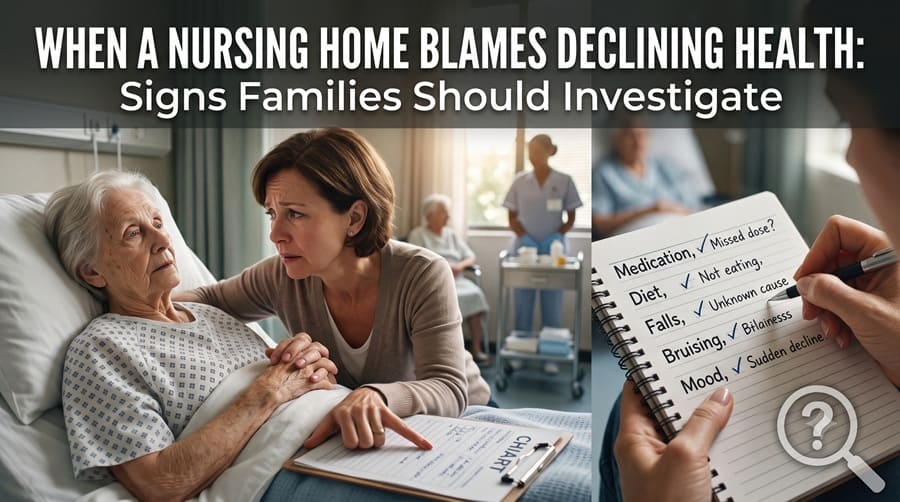
When a Nursing Home Blames Declining Health: Signs New York Families Should Investigate
By Shane Bornstein, Esq. | Associate Attorney, Bornstein & Emanuel, P.C. | Last reviewed: September 2026
Bottom line: A fall, pressure injury, weight loss, dehydration, or change in behavior does not automatically prove nursing home neglect. Older adults often have serious medical conditions that can cause decline even with appropriate care. The more useful question is whether the facility recognized the change, reassessed the resident, updated the care plan when needed, notified appropriate clinicians, and followed through on the interventions the resident required.
Your mother has fallen twice in a month. Your father has lost noticeable weight. A pressure injury appears, or a loved one who once enjoyed visits suddenly seems withdrawn. When you ask what happened, you may hear that these changes are simply part of getting older.
Sometimes age and illness do explain a decline. Nursing home residents often live with limited mobility, dementia, diabetes, stroke-related impairment, swallowing problems, or other chronic conditions that increase the risk of injury. But vulnerability is not a substitute for an explanation. It is often the reason closer assessment and more individualized care are needed.
Age Does Not Answer Every Question
Federal nursing-home rules require participating facilities to assess residents and develop an individualized care plan, then revise that plan as the resident’s needs change. CMS survey guidance likewise focuses on ongoing assessment, resident-specific care planning, and whether staff actually implement the plan.CMS nursing home guidance
New York law adds state-level resident protections. Public Health Law § 2803-c gives nursing home residents rights that include adequate and appropriate medical care, respectful treatment, and freedom from mental and physical abuse. A resident’s preexisting illness does not erase those protections.New York Public Health Law § 2803-c
If you notice a decline, ask specific questions rather than accepting a general explanation:
- When did staff first document the change?
- Was the resident reassessed after the change?
- Was the attending physician, nurse practitioner, or other clinician notified?
- Was the care plan revised?
- What new intervention was started, and is staff documenting whether it is working?
The important issue is not whether the resident was already medically fragile. It is whether the facility responded appropriately to the risks it knew about or should have recognized.
Repeated Falls Should Trigger a Fresh Review
One fall does not automatically mean a nursing home provided inadequate care. Falls can happen even when reasonable precautions are in place. A second or third fall, however, should prompt a closer look at what the facility learned from the earlier event and what changed afterward.
Useful questions include:
- Was the resident’s fall risk reassessed?
- Did staff review whether the resident needed more help with walking, toileting, transfers, or getting out of bed?
- Were medications reviewed for dizziness, sedation, or blood-pressure effects?
- Was new equipment or supervision recommended?
- Do the nursing notes show that the new precautions were actually followed?
A chart that repeatedly describes a resident as “unsteady” but does not show how the care plan changed may deserve further review. The same is true when incident reports, nursing notes, and family explanations do not line up.
Pressure Injuries Are About Risk Recognition and Response
Residents who spend long periods in bed or in a wheelchair have a greater risk of pressure injuries, sometimes called bedsores. CMS specifically notes that some residents can develop pressure injuries despite good preventive care. That is why the presence of a wound, by itself, does not prove neglect.CMS nursing-home quality measure guidance on pressure injuries
The stronger questions concern prevention and response. Depending on the resident’s condition, the record may show repositioning schedules, skin assessments, nutrition support, pressure-relieving surfaces, wound measurements, physician or wound-specialist involvement, and changes in treatment when the wound worsens.
Families may have more reason for concern when a pressure injury was not recognized promptly, deteriorated without a documented treatment response, or appears in records under conflicting dates or stages.
Weight Loss and Dehydration Need Context, Not Assumptions
Illness, dementia, medication changes, depression, swallowing problems, dental issues, and reduced appetite can all cause weight loss in an older adult. The key is whether the facility identified the cause and responded to it.
If your loved one is losing weight or seems dehydrated, ask whether staff are documenting meal and fluid intake, whether the resident needs assistance eating or drinking, whether swallowing has been assessed, and whether a physician or dietitian has evaluated the change. CMS quality materials recognize that significant weight loss can reflect illness, poor intake, feeding problems, or poorly managed care.CMS nursing-home quality measures
Behavioral Changes Can Be a Clue—but Not Proof
A resident who becomes withdrawn, anxious, fearful, unusually sleepy, or agitated may be reacting to many things: infection, pain, medication changes, dementia, depression, sleep disruption, a new roommate, or mistreatment. A sudden change does not prove abuse.
Still, patterns matter. Write down when the behavior occurs, who is present, whether medications recently changed, and whether the facility has evaluated a possible medical cause. A noticeable change that is dismissed without assessment deserves more questions.
What Records Can Help Explain What Happened?
Families concerned about possible nursing home abuse or neglect should focus on contemporaneous records rather than conclusions. Depending on the issue, useful materials can include:
- care plans and care-plan revisions;
- nursing progress notes and physician or practitioner notes;
- fall-risk assessments and incident reports;
- medication administration records;
- food and fluid intake logs and weight records;
- skin assessments, wound measurements, and wound-care notes;
- therapy records and transfer-assistance documentation;
- hospital or emergency-department records after an injury;
- family communications, photographs, and your own dated notes.
If you want to understand who oversees medical care inside a facility, Find The Lawyer also explains what nursing home medical directors do. For a broader discussion of preserving proof after an injury, see how accident evidence is collected and used in injury claims.
First-Party Case Example: Why the Paper Trail Matters
Bornstein & Emanuel’s published results include a $1.7 million Nassau County trip-and-fall recovery. The results page does not identify that matter as a nursing-home case, so it should not be presented as one. It is still a useful reminder that an injury case often turns on reconstructing exactly what happened, documenting the condition that caused the harm, and connecting the injury to reliable records rather than assumptions.Bornstein & Emanuel case results
For nursing-home concerns, the same evidence discipline matters: dates, chart entries, care-plan changes, incident reports, photographs, and medical findings can help distinguish an unavoidable decline from a failure to respond to a known risk. Prior results do not guarantee any future outcome.
What New York Law Adds to the Analysis
New York Public Health Law § 2801-d allows a nursing-home resident to bring a private action when a residential health care facility deprives the resident of a right or benefit created by contract, state law, regulation, or applicable federal law and that deprivation causes injury. Whether that statute—or a negligence or malpractice theory—applies depends on the facts and should not be assumed from a bad outcome alone.New York Public Health Law § 2801-d
Families can also report suspected regulatory violations to the New York State Department of Health. The Department investigates complaints involving nursing-home abuse, neglect, mistreatment, and other potential state or federal violations. Complaints may be submitted through the state’s nursing-home complaint process, and the hotline is 1-888-201-4563.New York State Department of Health nursing-home complaint information
What Families Can Do When the Explanation Does Not Match What They See
- Get urgent medical help first if the resident appears to be in immediate danger or has a serious new injury.
- Write down dates of falls, wounds, weight changes, hospital transfers, and noticeable changes in behavior.
- Ask for a care-plan meeting and request a clear explanation of what changed after each significant event.
- Keep copies of emails and letters, and confirm important conversations in writing when possible.
- Photograph visible injuries when appropriate and respectful of the resident’s privacy.
- Ask what records exist and how to request them.
- If the concern may involve a regulatory violation, consider a complaint to the New York State Department of Health.
Do not alter records, secretly access another resident’s information, or assume that one inconsistent note proves wrongdoing. The goal is to build an accurate timeline and identify where the medical explanation, care plan, and actual response do—or do not—match.
Look for Patterns, Not One Bad Day
Not every fall, pressure injury, infection, period of weight loss, or hospital transfer means a nursing home failed a resident. Older adults can experience serious decline even when they receive appropriate care. A fair review starts with that reality.
The concern becomes stronger when there is a pattern: repeated injuries without reassessment, unexplained delays in treatment, worsening wounds without documented changes in care, significant weight loss with little follow-up, missing or contradictory records, or explanations that keep changing. Those facts do not decide liability by themselves, but they are reasonable reasons to ask for more information.
Frequently Asked Questions
Does a fall in a nursing home automatically mean neglect?
No. Residents can fall despite reasonable precautions. The more important questions are whether the facility identified the resident’s fall risk, responded to earlier falls, updated the care plan when needed, and implemented appropriate precautions.
Are bedsores always evidence of nursing home neglect?
No. Some high-risk residents can develop pressure injuries despite appropriate preventive care. A review should consider the resident’s risk factors, skin assessments, repositioning, nutrition, support surfaces, wound treatment, and whether the facility responded when the condition changed.
Is unexplained weight loss a warning sign?
It can be. Weight loss may result from illness, dementia, medication effects, swallowing problems, depression, or poor intake. Families should ask whether intake was monitored, assistance was provided, and a clinician or dietitian evaluated the change.
What should I document if I suspect nursing home neglect?
Keep a dated timeline of falls, injuries, weight changes, hospital visits, conversations, and visible conditions. Save written communications and photographs where appropriate. Ask about care plans, nursing notes, incident reports, medication records, food and fluid logs, and wound-care documentation.
How do I report nursing home neglect in New York?
The New York State Department of Health accepts nursing-home complaints involving abuse, neglect, mistreatment, and possible regulatory violations. The state provides an online complaint process and a Nursing Home Complaint and Discharge Appeal Hotline at 1-888-201-4563.
Disclaimer
This article is for general educational purposes only and is not legal or medical advice. A decline in a nursing home resident’s condition may have medical causes unrelated to neglect, and whether a facility violated a legal duty depends on the specific facts, records, governing regulations, and applicable law. Reading this article does not create an attorney-client relationship. Families with concerns about a resident’s health should seek appropriate medical care and, when needed, advice from a licensed attorney in the relevant jurisdiction.
Authorities & Sources
- Centers for Medicare & Medicaid Services – Nursing Homes: Federal Requirements and Survey Guidance
- CMS Provider Data Catalog – Nursing Home Quality Measures
- New York Public Health Law § 2803-c – Rights of Patients in Certain Medical Facilities
- New York Public Health Law § 2801-d – Private Actions by Patients of Residential Health Care Facilities
- New York State Department of Health – Complaints About Nursing Home Care
