


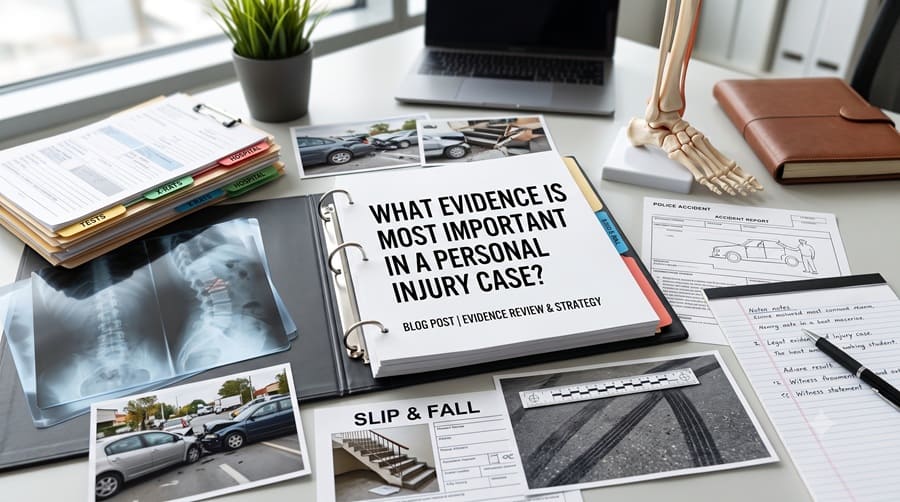
What Evidence Is Most Important in an Iowa Personal Injury Case?
By Max E. Kirk, Shareholder, Ball, Kirk & Holm, P.C. (Waterloo and Iowa City, Iowa) | Last reviewed: September 2026
Where to Start
Every injury claim has to answer three questions: Who caused this? What injuries did it cause? What has it cost you? The most important evidence is whatever answers those questions most convincingly in your case. For most people that means consistent medical records, photos or video from the scene, independent witnesses, and documents showing lost income and actual medical costs.
In Iowa, two rules shape how that evidence gets weighed: you generally have two years to file suit, and you can recover only if your share of fault is no greater than the combined fault of those you’re suing.
Everything changes in a few seconds. Afterward, you’re juggling pain, appointments, missed shifts, and insurance calls, and someone is already asking you to prove what happened. Knowing what actually matters as evidence can take some of the guesswork out of it, and some of the pressure off.
The Three Things Your Evidence Has to Prove
Insurance adjusters and juries evaluate a claim by breaking it into the same three parts. Evidence that answers more than one question at once tends to carry the most weight.
| Question | Evidence that usually answers it | Where it tends to fall short |
| Fault: who caused the accident? | Scene photos and video, independent witnesses, the investigating officer’s report, vehicle damage, incident reports | No witnesses, video overwritten, conflicting statements |
| Injury: what harm did it cause? | Emergency and follow-up medical records, imaging, specialist notes, photos of visible injuries | Delayed treatment, gaps between visits, symptoms not reported to doctors |
| Loss: what has it cost you? | Pay stubs, employer letters, tax returns, amounts actually paid for care, receipts, a daily symptom journal | Missing wage records, no documentation of day-to-day limits |
Medical Records: Usually the Most Important Evidence
If one category carries more weight than any other, it’s the medical record. It ties the injury to the accident, shows how serious it was, and tracks recovery over time. The most persuasive records start soon after the accident and continue without long gaps.
Gaps are where claims weaken. If you wait three weeks to see a doctor, or stop physical therapy for two months, the insurer will argue either that you weren’t really hurt or that something else caused the problem. Tell every provider about every symptom, including ones that seem minor, and mention the accident at the first visit so it’s written into the history.
You have a federal right to copies of your own records. Under the HIPAA Privacy Rule, 45 C.F.R. § 164.524, providers generally must respond to a written request within 30 days and may charge only a reasonable, cost-based fee. Keeping your own organized set, as MedlinePlus suggests for personal health records, makes it easier to spot missing visits and to answer questions about your treatment months later.
Iowa Looks at What Was Paid, Not What Was Billed
This is one of the least understood rules in Iowa injury law. Under Iowa Code § 622.4, evidence of past medical expenses is limited to the amounts actually paid to satisfy the bills, plus the amounts actually needed to pay bills still outstanding, capped at what your health insurance would pay. Section 668.14A limits recovery for past medical care the same way.
In practice, a $40,000 hospital bill that your insurer settled for $14,000 is generally treated as $14,000. That makes explanation-of-benefits statements, payment histories, and lien letters from insurers just as important as the bills themselves. Keep all of them.
Photos, Video, and Scene Evidence
Photos taken in the first hour often become the most convincing proof of how an accident happened. Vehicle damage and final positions, skid marks, a wet floor with no warning sign, a broken stair tread, poor lighting, visible bruising: all of it can change or disappear by the next day. Take wide shots that show the setting and close-ups that show detail, and keep the original files, which carry date and location data.
Video is more fragile. Store and doorbell cameras commonly overwrite footage within days, so ask for it in writing right away. This guide to what to do after a car accident walks through collecting scene evidence step by step.
Witnesses and Official Reports
An independent witness, someone with no connection to either side, can settle a dispute that photos can’t. Get names and phone numbers at the scene if you can; memories fade quickly and people become hard to find.
Official reports need a closer look in Iowa. Under Iowa Code § 321.266, a crash causing injury, death, or at least $1,500 in property damage must be reported; if police don’t investigate, the driver files a written report with the Iowa DOT within 72 hours. That driver-filed report, however, can’t be used as evidence in any civil or criminal case arising from the crash under § 321.271. An investigating officer’s report is different: parties and their insurers or attorneys can obtain a copy for a small fee, and it often contains the diagrams, statements, and citations adjusters rely on. For falls in stores or workplaces, ask whether an incident report was prepared and request a copy.
Proof of Lost Income and Everyday Limits
Financial losses need paper. Pay stubs, a letter from your employer confirming missed time, tax returns for the self-employed, and receipts for mileage, prescriptions, braces, and help around the house all document the economic side of a claim.
The harder part to prove is how the injury changed daily life. A short daily journal covering pain level, sleep, what you couldn’t do, and missed events creates a record that’s difficult to dismiss. Pain and suffering is compensable, but insurers rarely take anyone’s word for it; this discussion of emotional distress claims shows how courts look for that kind of documentation. (The legal standards there are Nevada’s, but the documentation principles carry over.)
When Key Evidence Is Missing
No photos, a thin police report, or a driver who now blames you doesn’t automatically end a claim. It means the remaining evidence has to fit together more tightly. In a rear-end crash with no video, the damage pattern, repair estimate, and a same-day ER visit can tell a consistent story. In a store fall with no witnesses, your shoes, clothing, the incident report, and a prompt medical exam may carry the case.
What you post can also become evidence against you. Insurers routinely check social media, and a photo from a family gathering can be framed as proof you’re fine. Posting less, and keeping accounts private, is the safest approach while a claim is open.
A Ladder That Became the Center of a Trial
Sometimes the most important evidence is an object. Ball, Kirk & Holm tried a product liability case over a defective ladder design; the firm’s case results list it as a $2.434 million trial win. In a design-defect case, the product and its design documentation are what the jury ultimately evaluates.
The practical lesson reaches beyond ladders. If a product was involved in your injury (a ladder, a tool, a car seat, a space heater), don’t throw it away, repair it, or return it to the store. Keep it as-is, along with the packaging, manual, receipt, and any labels, and photograph it before anything else happens to it.
Past results do not guarantee a similar outcome. Every case depends on its own facts.
Iowa Deadlines and Fault Rules That Affect Your Evidence
Most Iowa personal injury lawsuits must be filed within two years of the injury under Iowa Code § 614.1(2). Evidence gathered after that deadline doesn’t help if the claim is already barred.
Iowa also applies modified comparative fault under § 668.3. You can recover as long as your fault isn’t greater than the combined fault of the parties you’re suing, and your damages are reduced by your percentage. Evidence that answers the “who caused this” question isn’t only about proving the other side was careless; it’s also about keeping your own share as low as the facts allow.
Many people handle minor claims directly with the insurance company. When injuries are serious, fault is disputed, or a product or business may be responsible, people often consult an Iowa personal injury lawyer early, mainly so evidence is requested and preserved before it disappears.
Three Things to Do This Week
- Get evaluated and follow through. See a provider, describe every symptom, mention the accident, and keep follow-up appointments.
- Put everything in one place. Photos, receipts, explanation-of-benefits statements, discharge papers, repair estimates, and insurance letters, in one folder or secure digital file.
- Be careful what you say. Stick to facts with insurers, don’t guess about speeds or distances, and avoid posting about the accident or your recovery.
Frequently Asked Questions
What is the strongest evidence in a personal injury case?
Usually medical records that begin soon after the accident and continue consistently, combined with evidence of fault such as photos, video, or an independent witness. Each piece is strongest when it agrees with the others.
Can my Iowa accident report be used in court?
The report a driver files with the Iowa DOT can’t be used as evidence in a case arising from the crash. An investigating officer’s report is available to the parties and is commonly used by insurers.
Does a gap in medical treatment hurt my claim?
It often does. Insurers argue a gap means the injury wasn’t serious or had another cause. If there was a reason for the gap, such as cost, childcare, or waiting for a specialist, document it.
How do I prove pain and suffering?
Through consistent medical records that note your pain, a daily journal of how the injury affects sleep, work, and activities, and statements from people who see the difference day to day.
How long do I have to file a personal injury claim in Iowa?
Generally, two years from the date of injury. Some claims, including those against government entities or involving medical care, follow different rules.
Disclaimer
This article provides general information about evidence in Iowa personal injury claims and is not legal advice. Reading it does not create an attorney-client relationship. Laws change, and every claim depends on its specific facts. If you were injured, speak with a licensed Iowa attorney about your situation.
