


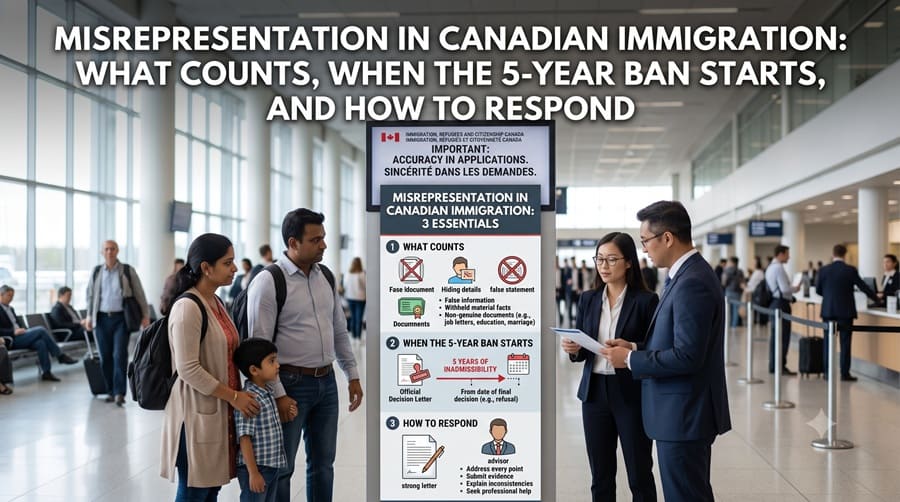
Misrepresentation in Canadian Immigration: What Counts, When the 5-Year Ban Starts, and How to Respond
By Austin Mandall Rooplall, Principal Lawyer & Founder, Mandall Immigration Law, Toronto | Last reviewed: September 2026
Quick Answer
Misrepresentation under section 40 of the Immigration and Refugee Protection Act (IRPA) means misstating or leaving out a material fact that could lead an officer to make a mistake. A finding usually makes you inadmissible for five years. That clock starts on the date of the final decision if it was made outside Canada, or on the date a removal order is enforced if it was made inside Canada. During those five years, a foreign national cannot apply for permanent residence. If you have received a procedural fairness letter, you still have a chance to answer before any finding is made, and that response is often the most important document in the file.
A misrepresentation letter from IRCC tends to arrive quietly, often months into processing. It usually points to one thing: a refusal from another country that was not listed, an employment letter whose details do not match tax records, or a gap in travel history. For many applicants, it is the first time they learn that an agent filled in a form incorrectly or that a question they thought was irrelevant was treated as important. This guide explains how the law works, where the five-year period actually begins, and what realistic options exist at each stage.
What IRCC Treats as Misrepresentation
Section 40(1)(a) of IRPA makes a permanent resident or foreign national inadmissible for directly or indirectly misrepresenting or withholding material facts that induce, or could induce, an error in administering the Act. Three parts of that wording do most of the work.
- “Directly or indirectly.” You can be responsible for a false statement made by someone else on your behalf, such as a consultant, recruiter, employer, or family member. IRCC’s fraud guidance states that false information sent by you, your representative, or your interpreter carries the same consequences.
- “Withholding.” Silence counts. Not listing a previous visa refusal, a prior marriage, a child, or a criminal charge can be enough, even if every answer you did give was accurate.
- “Could induce an error.” The officer does not have to have been fooled. It is enough that the missing or false information could have affected the decision or cut off a line of inquiry.
This sits alongside section 16 of IRPA, which requires applicants to answer truthfully and provide the documents an officer reasonably asks for. Section 40 also covers people sponsored by someone later found to have misrepresented (only where the Minister is satisfied the facts justify it), people whose refugee protection is vacated, and people whose citizenship is revoked for fraud.
Situations that commonly lead to a finding include:
- A U.S., U.K., Schengen, or Australian visa refusal that was not disclosed
- Employment letters with inflated duties, hours, or salaries, or letters from a business that cannot be verified
- Bank statements that were borrowed, altered, or show funds parked temporarily
- Language test results or diplomas that fail verification
- Undisclosed relationships, children, or previous spouses in sponsorship and PR files
- Misstated physical presence on PR card renewals or citizenship applications
Honest Mistakes: Why “I Didn’t Mean It” Is Not Always Enough
Intent is not a required element of section 40. The Federal Court has recognized a narrow exception for innocent misrepresentation, but it applies only where the applicant honestly and reasonably believed they were not withholding material information, often because the information was genuinely outside their knowledge. Believing a refusal was “too old to matter,” or that an agent would handle the forms, usually does not qualify.
That said, not every error is material. A misspelled street name or a transposed date that is corrected by other documents in the file is different from a missing refusal. Courts have also said officers must look at the whole picture when deciding materiality, including whether the applicant corrected the information on their own before IRCC raised it. Voluntarily correcting an error early is almost always better than waiting to see whether anyone notices.
When the Five Years Actually Starts
Many online guides describe the ban as “five years from refusal.” That is only true in some situations. Under IRPA s. 40(2)(a), the start date depends on where the finding was made.
| Where the finding happened | Five-year period runs from | What else applies |
| Outside Canada (for example, a visitor visa, study permit, or PR application refused abroad) | The date of the final determination of inadmissibility | You cannot apply for permanent residence during the five years (s. 40(3)). A judicial review can affect when the determination becomes final. |
| Inside Canada (for example, a PR or in-Canada temporary application leading to a removal order) | The date the removal order is enforced, meaning the date you leave or are removed | Staying in Canada does not run down the clock. A person removed on an exclusion order for misrepresentation needs an Authorization to Return to Canada within the five years. |
| Citizenship application | The misrepresentation decision in the citizenship process | The Citizenship Act, s. 22 bars a grant of citizenship during the prohibited period. |
The Authorization to Return to Canada (ARC) requirement comes from IRPA s. 52 and section 225 of the Regulations. IRCC’s ARC guidance confirms that anyone who wants to return less than five years after an exclusion order for misrepresentation was enforced must apply for one.
For permanent residents, the stakes are higher. A misrepresentation finding can lead to an admissibility hearing and a removal order, and permanent resident status is lost once that order becomes final. Citizenship obtained through fraud can be revoked.
If You Received a Procedural Fairness Letter
A procedural fairness letter (PFL) means an officer has concerns but has not yet made a finding. It is the best opportunity you will have, and it usually comes with a short deadline stated in the letter. If you need more time to gather records, ask for an extension in writing before the deadline passes.
- Identify exactly what is alleged. PFLs are sometimes vague. Write down each specific statement, document, or omission the officer mentions.
- Pull every earlier application. Compare this file against past Canadian and foreign applications. Inconsistencies between applications are a frequent trigger, and you may need your old forms through an access-to-information request.
- Get independent proof. Tax slips, pay stubs, bank records obtained directly from the bank, employer confirmation on letterhead with a reachable contact, school transcripts, or the original refusal letter from another country.
- Explain, do not argue. A clear, dated timeline supported by documents persuades more than a long letter insisting on good faith. If you rely on an honest mistake, a sworn declaration setting out what you knew and why is usually needed.
- Address materiality directly. If the information would not have changed the outcome, say why, with evidence.
Avoid sending a new application to “fix” the problem while a PFL or refusal is outstanding. A second set of forms that contradicts the first can create a fresh allegation.
An Employment Letter, a T4 Slip, and Four Missing Months
[Editor: anonymized account from the firm’s practice — confirm details with Austin Mandall Rooplall before publishing.]
A Toronto-based software tester applying for permanent residence through Express Entry received a procedural fairness letter. The officer noted that his employment letter described full-time work for the whole year, while his T4 slip showed noticeably lower earnings. The letter raised the possibility that he had overstated his Canadian work experience, which would have been material because that experience helped qualify him.
He had first tried to draft a response himself: a short note saying the letter was accurate and asking IRCC to reconsider. When the file came to Mandall Immigration Law, the team started with the numbers rather than the explanation. His pay stubs showed that he had taken four months of unpaid leave to care for a parent overseas, and his employer’s HR department had used a template that listed only his start date and current status.
The response included a corrected letter from HR confirming the leave dates, his pay stubs, the approved leave request, and a sworn declaration explaining why the original letter was incomplete. It also showed that, even without those four months, he still met the minimum Canadian experience requirement for the program. The officer accepted the explanation, and the application moved on to approval.
What made the difference was not tone or apology. It was showing that the gap had an ordinary cause, was documented by third parties, and did not change his eligibility.
Challenging or Working Around a Misrepresentation Finding
Once a finding is made, the options depend on the kind of application and where you are.
| Option | When it may fit | Key limits |
| Judicial review in Federal Court — IRPA s. 72 | The officer ignored evidence, was unfair, or reached an unreasonable decision | Requires leave. The application must be filed within 15 days for decisions made in Canada and 60 days for decisions made outside Canada. The court sends the matter back for a new decision; it does not grant the visa. |
| Immigration Appeal Division — IRPA s. 63 | Permanent residents facing a removal order; sponsors of a spouse, common-law partner, or child | Section 64(3) removes appeal rights for other family-class misrepresentation refusals, as IRCC’s ENF 19 manual explains. |
| Reconsideration request | A clear error, such as the officer overlooking a document that was submitted | Discretionary. Officers are not required to reopen a file, and a request does not pause the judicial review deadline. |
| Temporary Resident Permit — IRPA s. 24 | A compelling reason to be in Canada temporarily during the five years | Discretionary and temporary. It does not remove the inadmissibility or the permanent residence bar. |
| Waiting out the period | No realistic basis to challenge the finding | Future applications should disclose the finding in full. Hiding it would be a new misrepresentation. |
Deadlines matter more than anything else in this table. Missing the 15-day judicial review window in Canada is one of the most common and least reversible mistakes after a refusal.
Getting the File Reviewed Before You Respond
Not every misrepresentation concern needs a lawyer, but most do once a five-year bar or loss of status is possible. Whether you consult a licensed immigration consultant, a legal clinic, or an Immigration Lawyer Toronto residents use for refusals and Federal Court work, bring the full picture: the PFL or refusal letter, every application you have ever submitted to Canada, any foreign refusal letters, and the documents behind the disputed information. Ask the representative to explain whether the issue is likely material, what the deadline is, and whether an honest-mistake argument is realistic on your facts.
If an unlicensed agent prepared your application, tell the new representative. It does not excuse the misrepresentation, but it can matter to how the explanation is framed and whether the agent should be reported.
Frequently Asked Questions
Can I apply for a visitor visa or work permit during the five-year ban?
The permanent residence bar in section 40(3) is absolute during the period, but temporary applications are not legally barred in the same way. In practice, you remain inadmissible, so a temporary application will usually be refused unless it is paired with a successful Temporary Resident Permit request.
Does a misrepresentation finding affect my family members?
It can. Family members included in the same application may also be refused, and a sponsor found to have misrepresented can affect the people they sponsored where the Minister is satisfied the facts justify it.
Is a refusal under section 16 the same as misrepresentation?
No. Section 16 refusals are for failing to answer truthfully or provide requested documents and do not carry the automatic five-year bar. But the same facts can support a section 40 finding, so a section 16 concern should be taken seriously.
What if my old application had an error I have only just noticed?
Correct it voluntarily and in writing, with supporting documents, before IRCC raises it. Early, candid correction is a factor officers and courts consider when deciding whether an error was material.
Will the finding stay on my record after five years?
The inadmissibility ends, but IRCC keeps a record of the finding. Future applications should disclose it, and officers may look more closely at your documents.
The Point to Remember
A misrepresentation allegation is serious, but it is not always a foregone conclusion. The outcome often turns on three things: whether the information was truly material, whether it can be explained with independent documents, and whether the response or challenge is filed within the deadline. Read the letter carefully, gather your full immigration history, and get the file reviewed before you reply.
Disclaimer
This article provides general information about Canadian immigration law as of September 2026. It is not legal advice, and reading it does not create a lawyer-client relationship. Immigration law, IRCC policies, and processing practices change frequently, and outcomes depend on the specific facts and documents in each file. The anonymized example is included for illustration; past outcomes do not guarantee similar results. If you have received a procedural fairness letter, refusal, or removal order, speak with a licensed Canadian immigration lawyer or regulated consultant promptly, as strict deadlines may apply.
Authorities & Sources
- Immigration and Refugee Protection Act, S.C. 2001, c. 27, s. 16 (obligation to answer truthfully)
- IRPA, s. 24 (temporary resident permits)
- IRPA, s. 40 (misrepresentation; five-year period; PR application bar)
- IRPA, s. 52 (authorization to return to Canada)
- IRPA, s. 63 (rights of appeal to the Immigration Appeal Division)
- IRPA, s. 64 (no appeal for certain misrepresentation refusals)
- IRPA, s. 72 (judicial review; filing deadlines)
- Immigration and Refugee Protection Regulations, SOR/2002-227, s. 225 (exclusion orders)
- Citizenship Act, R.S.C. 1985, c. C-29, s. 22 (prohibitions on grant of citizenship)
- IRCC — Consequences of immigration and citizenship fraud
- IRCC — Reasons you may be inadmissible to Canada
- IRCC — Authorization to return to Canada: Who needs an authorization
- IRCC Operational Manual ENF 19 — Appeals before the Immigration Appeal Division
